Colour-coded, Braille taps
Instead of: asking a coworker which handle is which.
You get: pouring your own round, at your own pace, all shift.
Make this page easier to read for you
Everyone eats here
Here is everything we've built, in plain language, so you can decide before you arrive whether this place works for you. If something you need isn't on this list, ask us anyway — we'd rather find a way than turn you away.
You never have to explain yourself here. Every item below is free, available on request, and normal. Nobody will ask you why you need it.
How we think about this
Most people picture an accommodation as something done for a disabled person — a helper, a shortcut, a lowered bar. In practice it is almost always the opposite. A good accommodation is the thing that removes the helper.
Our taps are the clearest example. They are colour-coded and labelled in Braille, so a bartender who is blind finds the right handle by touch and pours it alone — no colleague, no asking, no waiting. That is not assistance. That is a barrier being taken out of the way so somebody can just do their job.
The same logic runs through the whole building, for our staff and for you.
Instead of: asking a coworker which handle is which.
You get: pouring your own round, at your own pace, all shift.
Instead of: someone ordering on your behalf.
You get: choosing your own dinner, like everybody else at the table.
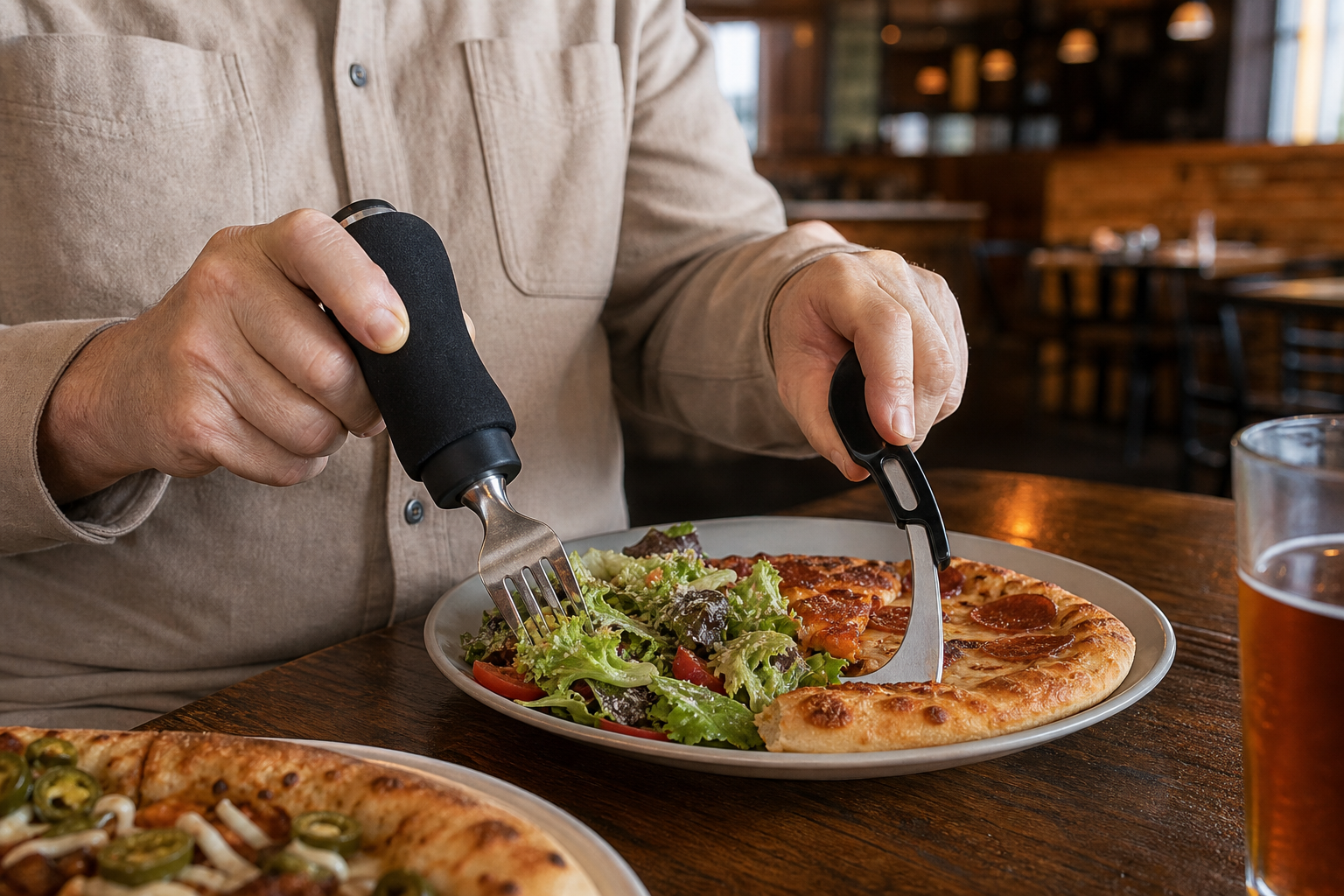
Instead of: being fed, or skipping the meal.
You get: eating your own food, in your own time.
Instead of: being lifted, or turned away at the door.
You get: arriving under your own steam and choosing your own table.
Instead of: leaving early when it gets loud.
You get: staying for the whole evening, on your terms.
Instead of: watching everybody else dance.
You get: feeling the music through the floor and dancing to it.
Accommodation is not special treatment. It is simply access to contribution.
None of this is charity, and none of it lowers a standard. It clears the path to one. More about why we build it this way →
Outside, there's a pedestrian crossing with a traffic light directly in front of our door, and a public parking lot across the street. Full directions, parking and bus routes →
Our tables aren't arranged for looks. Each shape solves something.
So Deaf and hard-of-hearing guests can see everyone's face and hands at once. At a long rectangular table, half the conversation is out of view.
Set at a height that works for people who use wheelchairs, so nobody eats at chest level or gets seated at the end of a table as an afterthought.
In a quieter part of the room, for guests with sensory sensitivity. Extra padded seats are available for anyone who is aging or in pain.
A restaurant is a loud, bright, unpredictable place. If it becomes too much — for you or for someone you're with — you can use any of this, at any time, without asking permission.
Everything here is free and available on request.
Reading a menu shouldn't be the hard part of dinner. Ask for whichever version works for you.
You can also order using sign language or our colour-coding system, whichever is easier.
Designed in from the start
Our beer taps are colour-coded and labelled in Braille, so a bartender who is blind can find the right handle and pour it independently — without asking a colleague. It's why every beer is named after a colour rather than a long beer name: Pink, Gold, Black, Yellow, Red, Blue, Green, Purple and White. You order by colour, and so do we.
Our dance floor vibrates, using bone-conduction technology, so the music travels up through your feet as well as through the air. Deaf and hard-of-hearing guests don't watch the dancing — they dance.
Neither of these is an accommodation added afterwards. They were designed in, and they make the place better for everyone — which is rather the point.
We think a restaurant that promises accessible menus should have an accessible website. This one is built to WCAG 2.2 AA, and you can change how it behaves using the Aa button at the top of every page:
Every page works with a keyboard alone, works with screen readers, and works at 400% zoom. Every photograph has a written description. Your settings are remembered between visits.
Found something that doesn't work? Please tell us — email brewabilitylab@gmail.com or call (720) 484-5341. We'll fix it, and we'd genuinely rather know.